


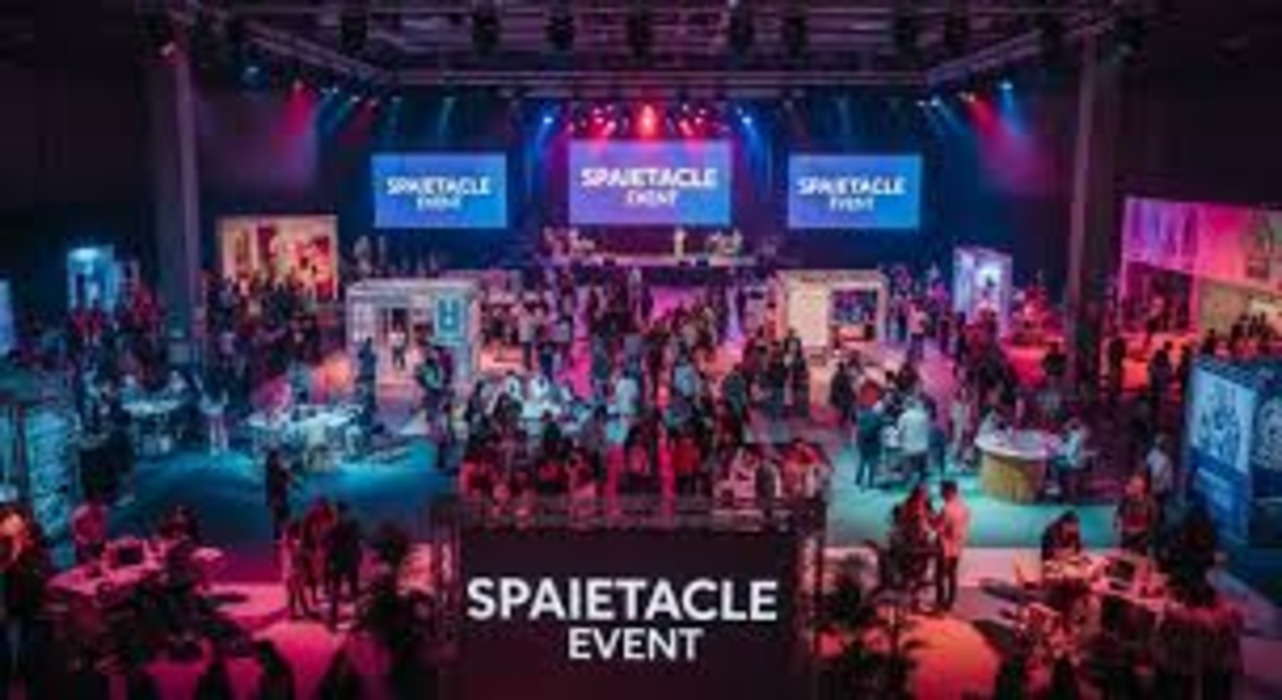
In today’s hyperconnected digital economy, attention has become the most valuable currency—and the battle for it is no longer won through functionality alone. It is won through experience. This is where the concept of spaietacle is beginning to surface in conversations among product designers, startup founders, and digital strategists. While still evolving as a term, spaietacle represents a shift toward immersive, emotionally engaging, and spatially aware digital experiences that go far beyond traditional interfaces.
For entrepreneurs and tech professionals building in competitive markets, understanding spaietacle is not just about keeping up with design trends. It is about recognizing how user expectations are fundamentally changing. People no longer interact with products—they experience them.
And that shift is rewriting the rules of engagement.
Understanding Spaietacle in a Modern Digital Context
At its core, spaietacle can be understood as the fusion of spatial awareness, narrative-driven design, and experiential immersion within digital ecosystems. It is the point where interfaces stop being static screens and start becoming dynamic environments.
In practical terms, spaietacle refers to how digital products create a sense of presence. Instead of users simply navigating software, they feel like they are inside a system that responds, adapts, and evolves with them.
For startups, this is particularly significant. The competition is no longer just about features or speed—it is about emotional resonance. Users remember experiences, not dashboards.
Spaietacle captures that shift.
Why Spaietacle Matters for Startups and Tech Founders
Startups operate in a landscape where differentiation is increasingly difficult. Most industries are saturated with similar products offering similar solutions. In such environments, user experience becomes the primary battleground.
Spaietacle introduces a new layer to this competition. It allows startups to design not just usable products, but memorable ones.
When users interact with a product shaped by spaietacle principles, they are not just completing tasks—they are engaging with a carefully constructed experience that guides emotion, attention, and behavior.
For founders, this matters because emotional engagement drives retention. Retention drives growth. And growth determines survival.
In this sense, spaietacle is not just a design concept. It is a business strategy.
The Evolution Toward Spaietacle-Driven Digital Experiences
To understand where spaietacle fits in, it helps to look at how digital experiences have evolved over time.
Early software focused on function. If it worked, it was successful. Later, usability became the focus. Interfaces were designed to be intuitive and accessible. Then came aesthetics, where visual design started playing a central role.
Now, we are entering a phase where none of these alone are enough.
Modern users expect fluid, responsive, and emotionally intelligent systems. They expect technology to feel less like a tool and more like an environment.
This is where spaietacle emerges—not as a replacement for UX or UI, but as an evolution of both.
It introduces dimension, continuity, and narrative into digital interaction.
Core Principles Behind Spaietacle Design
Although still an emerging concept, spaietacle can be broken down into several guiding principles that help explain its growing relevance in product development.
The first principle is immersion. Digital experiences should reduce friction between user intention and system response, creating a sense of flow.
The second principle is spatial awareness. Interfaces are no longer flat—they are layered, responsive environments that react to user movement and behavior.
The third principle is narrative continuity. Instead of isolated screens or actions, users experience a connected journey that feels coherent and meaningful.
The fourth principle is emotional feedback. Systems respond not just functionally, but contextually, reinforcing user engagement through subtle cues.
Together, these principles form the foundation of spaietacle-driven design thinking.
Spaietacle in Product and Experience Design
To understand how spaietacle transforms digital products, consider how it changes the design mindset.
Traditional product design often focuses on efficiency—how quickly can a user complete a task? Spaietacle shifts the focus toward experience quality—how meaningful does the interaction feel while completing that task?
This shift has major implications for startups building in competitive markets.
Below is a comparison of traditional design thinking versus spaietacle-oriented design:
| Design Dimension | Traditional Digital Design | Spaietacle-Driven Design |
| User Focus | Task completion | Experience immersion |
| Interface Style | Static and functional | Dynamic and responsive |
| Engagement Model | Click-based interaction | Flow-based interaction |
| Emotional Layer | Minimal or secondary | Central to design strategy |
| Product Goal | Efficiency and usability | Memory, engagement, and retention |
This comparison highlights a critical insight: spaietacle does not replace usability—it expands it.
How Spaietacle Impacts Startup Growth Strategy
For startups, product experience is directly tied to growth. A well-designed experience reduces churn, increases engagement, and improves word-of-mouth acquisition.
Spaietacle enhances all three.
When users feel immersed in a product experience, they are more likely to return. When interactions feel intuitive and emotionally satisfying, friction decreases. And when a product feels memorable, users are more likely to recommend it.
This creates a compounding effect that directly influences growth metrics.
In many ways, spaietacle becomes a silent growth engine embedded within the product itself.
Real-World Applications of Spaietacle Thinking
Although the term is still emerging, elements of spaietacle can already be seen in modern digital products.
Social platforms that use infinite scroll with adaptive content flows are creating subtle immersion. Productivity tools that visually respond to user behavior are introducing spatial awareness. Even e-commerce platforms that personalize browsing journeys are moving toward narrative-driven experiences.
In each case, the goal is the same: reduce the sense of interaction with a tool and increase the sense of participation in an environment.
For startups, this opens up new opportunities in product differentiation.
Instead of asking “What features should we build?”, the better question becomes “What experience are we creating for the user?”
Table: Where Spaietacle Shows Up in Digital Products
To better understand its practical presence, here is how spaietacle manifests across different product categories:
| Product Category | Spaietacle Application | User Experience Outcome |
| Social Media | Adaptive content flow and immersion | Increased engagement and session time |
| SaaS Platforms | Context-aware dashboards | Improved decision-making clarity |
| E-commerce | Narrative shopping journeys | Higher conversion rates |
| Gaming Interfaces | Fully immersive environments | Strong emotional engagement |
| EdTech Products | Interactive learning spaces | Better knowledge retention |
This demonstrates that spaietacle is not limited to one industry—it is a cross-sector design evolution.
Challenges and Misinterpretations of Spaietacle
Like many emerging concepts, spaietacle is often misunderstood.
One common misconception is that it is purely visual or aesthetic. While visual design plays a role, spaietacle is fundamentally about experience structure, not decoration.
Another misunderstanding is that it requires complex or expensive technology. In reality, spaietacle can be achieved through thoughtful design choices even in simple applications.
A third challenge is overdesign. In the pursuit of immersion, some products risk becoming overly complex, which can reduce usability.
The key is balance—maintaining clarity while enhancing experience depth.
The Future of Spaietacle in Digital Product Development
As digital ecosystems continue to evolve, spaietacle is likely to become more relevant rather than less. Advances in spatial computing, AI-driven personalization, and real-time rendering are all contributing to more immersive digital environments.
We are moving toward a world where interfaces will not feel like interfaces at all. Instead, they will feel like environments users inhabit.
In this future, spaietacle will likely become a foundational design philosophy rather than a niche concept.
Startups that understand this early will have a significant advantage in shaping next-generation user experiences.
How Startups Can Begin Applying Spaietacle Thinking
For founders and product teams, adopting spaietacle does not require a complete redesign of existing systems. It begins with small, intentional changes.
Start by examining how users feel during interaction—not just what they do. Look for friction points that break immersion or disrupt flow.
Next, consider how continuity can be introduced across different parts of the product. Even subtle transitions can significantly enhance perceived experience quality.
Finally, prioritize emotional feedback. Every interaction should communicate something back to the user, whether it is confirmation, progress, or responsiveness.
Over time, these small adjustments accumulate into a more immersive product experience.
Conclusion
Spaietacle represents a shift in how digital experiences are designed, perceived, and evaluated. It moves beyond traditional notions of usability and efficiency, introducing a more immersive, emotionally engaging approach to product design.
For startups, this shift is not optional—it is increasingly becoming essential. In markets where functionality is easily replicated, experience becomes the true differentiator.
By embracing the principles behind spaietacle, founders and product teams can build digital products that are not only useful, but also memorable, engaging, and deeply human in their interaction design.
In the long run, the companies that succeed will not just build software. They will build experiences people want to return to.